
What Are Research Peptides? A Complete Scientific Guide
Helix Division · July 11, 2026

What Are Research Peptides?
Research peptides are short chains of amino acids that scientists investigate to better understand biological processes at the molecular level. These compounds are widely used in laboratory environments to explore areas such as cell signaling, protein interactions, tissue biology, neuroscience, immunology, metabolism, and many other fields of biomedical research. Although some peptides have become approved medicines after years of clinical development, many research peptides remain investigational compounds intended solely for scientific study. Their role is to help researchers generate knowledge—not to serve as established medical treatments. This guide explains what research peptides are, how they are studied, why they are valuable to science, and the important distinctions between research compounds and approved therapeutic products

Quick Summary
Research peptides are laboratory compounds used to investigate biological mechanisms. They are studied in controlled scientific settings to advance understanding of physiology and disease but are not, by virtue of being research peptides, established treatments for human use.
Table of Contents
-What Is a Peptide? -What Makes a Peptide a Research Peptide? -Why Are Research Peptides Important? -Common Areas of Peptide Research -How Are Research Peptides Studied? -Research Peptides vs Therapeutic Peptides -Quality in Research -Limitations of Research -Frequently Asked Questions
What Is a Peptide?
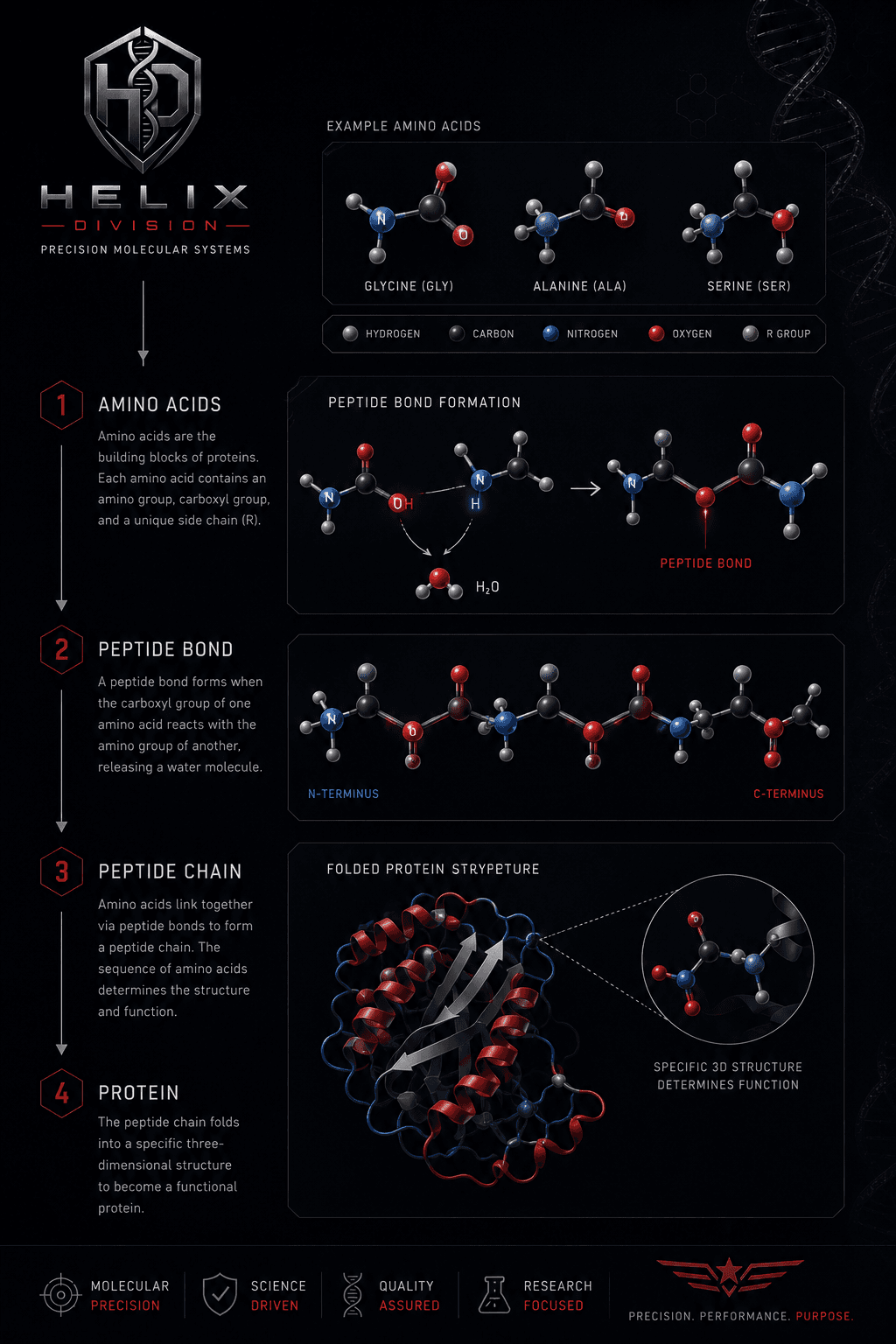
A peptide is a molecule composed of two or more amino acids linked together by peptide bonds. Amino acids are often described as the building blocks of proteins. While proteins may contain hundreds or even thousands of amino acids, peptides are generally much shorter. Their relatively small size often allows researchers to investigate specific biological interactions with greater precision. Many naturally occurring peptides function as signaling molecules within living organisms, influencing communication between cells and tissues. Researchers study these signaling pathways to better understand normal physiology and disease processes.
What Makes a Peptide a Research Peptide?
The term research peptide generally refers to a peptide being investigated for scientific purposes rather than used as an approved therapeutic product. Research peptides may be explored to: -Understand biological pathways -Investigate receptor interactions -Study cellular signaling -Explore tissue responses in laboratory models -Develop future scientific hypotheses Importantly, investigational research does not establish effectiveness or safety for clinical use. Findings from laboratory or animal studies may not translate directly to humans, and additional research is often required before clinical conclusions can be drawn.
Why Are Research Peptides Important?
Modern biomedical research relies on precise molecular tools to investigate how living systems function. Research peptides help scientists examine: -Cell communication -Immune signaling -Hormone regulation -Protein interactions -Molecular transport -Tissue biology -Gene expression pathways By isolating specific biological mechanisms, researchers can gain insights that contribute to scientific understanding and, in some cases, support the development of future therapeutic approaches after extensive research and regulatory evaluation.

Common Areas of Peptide Research
Cell Biology
Researchers investigate how peptides influence communication between cells and intracellular signaling networks.
Neuroscience
Certain investigational peptides are studied to better understand neural signaling, learning, memory, and neurobiology.
Immunology
Scientists examine peptide interactions involved in immune system regulation and inflammatory pathways.
Metabolic Research
Research explores how peptides may influence metabolic signaling and endocrine pathways in laboratory settings.
Regenerative Biology
Some preclinical studies investigate peptides in relation to tissue repair mechanisms, extracellular matrix biology, and cellular regeneration. These findings remain areas of ongoing research and should not be interpreted as established clinical outcomes.
How Are Research Peptides Studied?
Scientific investigation typically progresses through multiple stages. These may include:
In Vitro Research
Experiments performed using isolated cells or biological materials outside a living organism.
Animal Studies
Preclinical models may be used to investigate biological mechanisms before human clinical research is considered.
Clinical Research
Some investigational compounds may eventually enter carefully regulated clinical trials if sufficient preclinical evidence supports further evaluation.
Many research peptides never progress through every stage of development.

Research Peptides vs Therapeutic Peptides
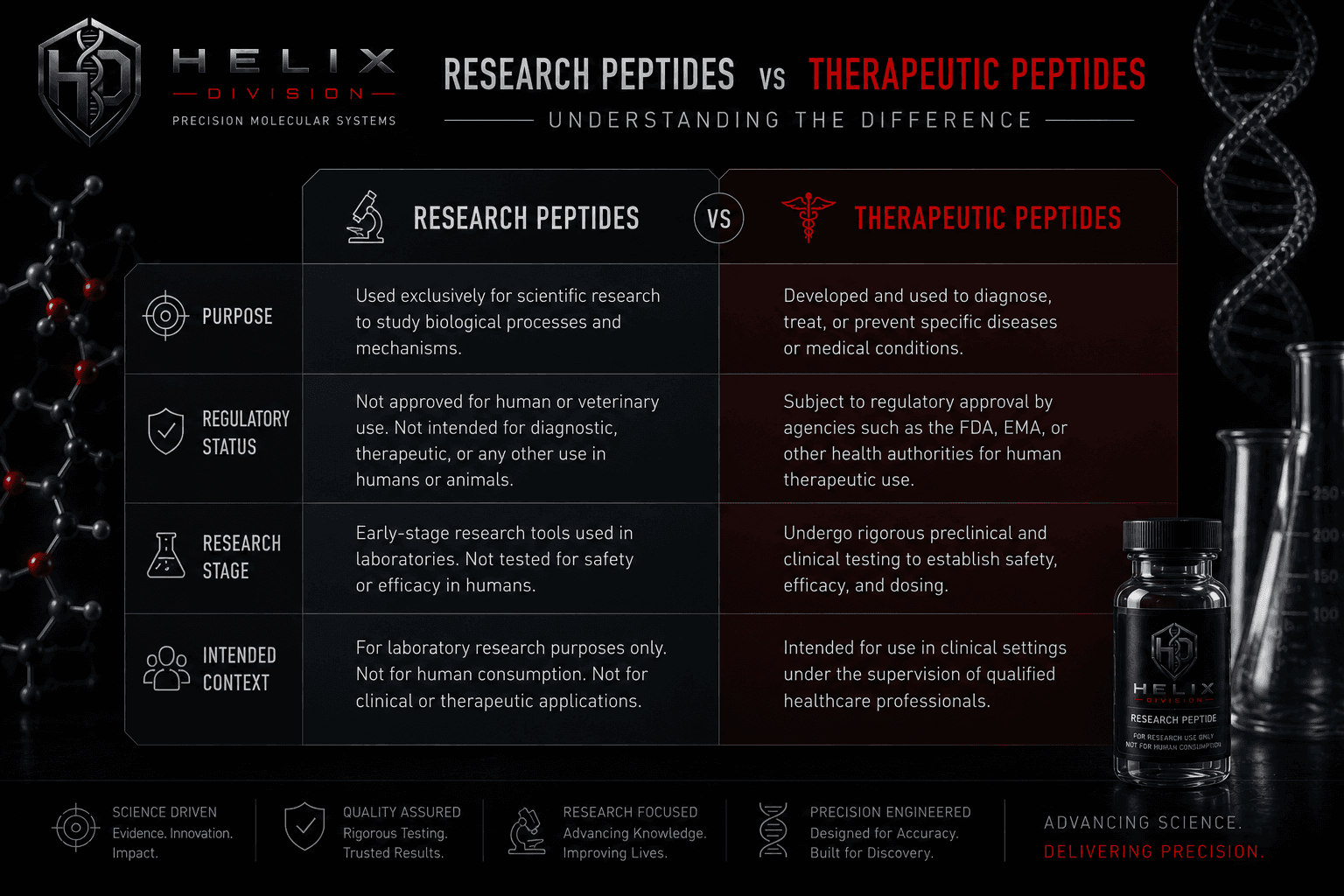
Research Peptides
-Investigational -Used to generate scientific knowledge -Studied in laboratory or preclinical settings -Not inherently established as safe or effective for clinical use
Therapeutic Peptides
-Approved for specific indications (where applicable) -Used in clinical practice according to regulatory approval -Evaluated through clinical trials and regulatory review -Subject to approved prescribing information and ongoing safety monitoring
Quality in Research
Reliable scientific research depends on well-characterized materials. Researchers commonly evaluate: -Identity verification -Analytical testing -Purity assessment -Batch consistency -Stability data -Certificates of Analysis (COAs) These quality measures support reproducibility and confidence in laboratory findings.
Related Reading
https://www.helixdivision.com/research/understanding-peptide-purity-standards
Limitations of Research
Scientific research is an evolving process. Individual studies rarely provide definitive answers on their own. Researchers evaluate: -Study design -Sample size -Replication -Statistical analysis -Independent confirmation Preclinical findings should not be interpreted as evidence of clinical effectiveness in humans.
Frequently Asked Questions
Are research peptides medicines?
Not necessarily. Many remain investigational compounds used to study biological systems and are not approved medicines.
Are all peptides used for research?
No. Some peptides occur naturally in living organisms, while others have become approved therapeutic products after extensive clinical development and regulatory review.
Why are peptides studied?
Researchers investigate peptides to improve understanding of biological processes, disease mechanisms, and molecular signaling.
Do laboratory findings always apply to humans?
No. Results from cell-based or animal research do not necessarily predict outcomes in human clinical settings.
Conclusion
Research peptides are valuable tools in modern biomedical science, enabling researchers to investigate complex biological systems at the molecular level. By supporting the study of cell signaling, physiology, and disease mechanisms, they contribute to the broader understanding of biology and may inform future scientific and medical advances. However, investigational findings should always be interpreted within the context of the available evidence and should not be viewed as established clinical conclusions.
Disclaimer
This article is provided solely for educational and informational purposes regarding laboratory research. It discusses research peptides within the context of scientific investigation and does not promote or recommend the use of investigational compounds in humans or animals. Nothing in this article should be interpreted as medical advice or as evidence of safety or effectiveness for clinical use. Products referenced by Helix Division are intended for research use only and are not for human consumption.
Research use only. Content is educational and does not constitute medical advice or a claim of human or animal efficacy or safety. Products referenced are not for human consumption.